Sunday, March 30, 2008

Week Eleven: "On the Rights of the Molotov Man"

“On the Rights of the Molotov Man,” an article by Joy Garnett and Susan Meiselas is a very interesting article in that it takes a look at how contextualizing and decontextualizing images can have an effect on their meaning and their representation of the subject included in the photo or image itself. However, I found the copyright infringement aspect of the article to be kind of ridiculous. While I understand that it had been Susan Meiselas original image, taken for a specific reason and with a specific purpose in mind, it was clear to me, from reading Joy Garnett’s portion of the article, that she had not created her painting with any intention of infringing upon Susan’s copyright. Getting the lawyer involved seemed to be going a little far. While I understand that it is important for an artist to protect their work and their creations, I also think the whole idea of copyright has been taken to the point of extremes in the art world, and in other areas of art more so than in the actual graphic arts, and it has gotten to the point where the phrase copyright infringement does not even carry as much weight as it used to.

However, the one part of the article that I found to be incredibly interesting was how artists online around the world stood up and fought for Joy Garnett’s right to use the image in her painting, since she had clearly not intended to infringe on anyone’s copyright by using it. She had simply found it in an internet search and felt inspired. Seeing that kind of backing from an online community is not all that surprising from me, since I, myself, take part in some online discussion communities for the arts and various things, but it was interesting to see how the story got twisted as it was translated from language to language. I think that is one thing that is universally understood… that language barriers can sometimes make things worse without intending to. For instance, the Chinese thought that Pepsi was suing Joy Garnett by the time the news got to them, and eventually, the whole thing was blown way out of proportion.

Though the whole situation did become blown out of proportion, I think that the online support that Garnett received for her painting had a lot to do with Meiselas having her lawyers back off and not going after the licensing fees. There would have been so many backlashes, that at the time, it probably didn’t seem worth pursuing. Even though she did give up on the legal pursuit, I’m glad that this article gave her the opportunity to voice her opinion and give the real background of the “Molotov Man.” His story is fascinating, and it was crazy to see how many different groups had used his image. Pablo Arauz, better known as the “Molotov Man,” had his image spread on flyers for various political parties, had his image put on match books, had his image painted on walls, and all the while, he was raising a family and taking care of the lumber company that he owned. It was not until 1990 that Susan Meiselas even knew the name of the man in the picture she had taken that had caused so much uproar… such a riot, in fact.

I think the most important question raised by this article was brought up by one of the online posters in response to the controversy and battle over copyright and rights in general between Joy Garnett and Susan Meiselas. “Who owns the rights to this man’s struggle?” Neither Garnett or Meiselas knew this man personally, other than Meiselas having witnessed him throwing the Molotov cocktail long enough to snap the photo that would bring her into the spotlight, but nowhere in the article did it mention asking Pablo Arauz’s permission to reproduce images of his likeness. It just seemed like such a trivial matter to me. It wasn’t a battle over art for art’s sake. It was a battle over rights, and ultimately over money for Susan Meiselas, and that kind of goes against everything that the image itself represented, as Arauz fought for political beliefs and freedom from a regime he didn’t believe in. Overall, I just felt like the article raised a lot of interesting questions about art and copyright as it relates to both 2-D and 3-D art.

Sunday, March 23, 2008

Week Ten: Brook, "The Rough Theater"

Though the excerpt from the Brook article, “The Rough Theater,” was fairly brief, it contained a lot of interesting information. I had never really thought about the architecture of theater before the article brought up many very interesting points. For instance, a rough theater can be more engaging than a clean cut, incredibly stylized theater performance/showing. While this seems like common sense after thinking about it, I had never really considered that to be true. Raw performances just seem to have more character overall. There is more of a chance for audience interaction with the performers because there is no expectation or uncomfortable urge to sit still and just “enjoy the show” in silence because of clean, seemingly perfect surroundings. In posh, sophisticated settings, audience-performer interaction during a show would be seen as inappropriate and rude, at least in most settings, but if a show is designed to be rather crude and simple, as far as style goes, and the theater itself is more homey and inviting, then a whole new atmosphere opens up and allows for an entirely different viewing experience. Beauty really is in the eye of the beholder in this sense, since all of it is merely based on opinions rather than fact.

Brook also brings up an interesting point in the article when there is a reference to prisoners in San Quentin being able to appreciate something as sophisticated as Waiting for Godot from their confinements in prison simply because it is constructed in a more simplified form. If those same prisoners were to go to a fancy, upper class theater in London, England, to see that show or a show of a similar style, then they would be completely lost because it would not be spoken in a language that they could understand, even if it was actually spoken in English. There are so many different levels of the English language that even people who speak the same language can come face to face with a language barrier of sorts.

One of the most interesting aspects of the article is how Brook discusses ways of simplifying stories to get the same effect. In a time where spectacle is more important to the Hollywood blockbuster than story is, for the most part, it was nice to see an analytical mind thinking about ways to simplify theater and get back to basics, in a way. Using flour to show someone white with fear is almost ingenious these days, since it is not even thought about with the use of makeup or even color alteration in post production with computers and other technologies.

Lastly, Brook discusses the idea of viewing shows outside of normal viewing areas as being more enriching than going to the theater or something of the sort. Though Brook is talking more about live theater than movie going, I can relate to what is being said. Outdoor theater allows for more interaction, and incorporating local jokes or slang phrases that more people would relate to is a great way of connecting with the audience. Personally, I think that going to film viewings that take place outdoors or in a setting other than a movie theater, such as a film screening with a projector and a white sheet in some guy’s garage, are more enjoyable at times than just going to see the run of the mill Hollywood blockbuster in a seat with a cup holder in the armrest and sticky candy on the floors. It allows for a nice break from reality in a visual sense, and it’s just a way to get outside of the realm of normalcy for a little while. Overall, it just creates an entirely new viewing experience all together, and I think that was the point that Brook tried to make in “The Rough Theater.”

Sunday, March 16, 2008

Week Seven: Double Time

Week seven of class brought about a double dose of 6x1 action. Not only did we meet in class on Monday morning, but we had a film shoot on Saturday that was fairly educational as well. The focus of the week was the one shot that we would be filming on Saturday using the Bolex film cameras provided for us by the school. With only one complete wind worth of film at our disposal, the class was broken up into groups and instructed to come up with a complete idea or action that could take place in front of the lens for one minute while the camera filmed at twelve frames per second before the film was developed, projected and recorded onto a mini DV, and then taken into Final Cut to be slowed down and have a soundtrack added.

While trying to come up with an action to take place in one minute in front of a camera when no dialogue is required sounds like an easy enough task, it actually proved to be quite difficult. Half of Monday’s class was devoted to our groups having time to get together to come up with a concept that would give us some kind of starting point when we showed up to film on Saturday afternoon. My group came up with an initial idea fairly quickly: we would follow one object around as it is passed amongst a group of random people. The next task was coming up with an object and a group of people doing distinct actions that would show up on film without the use of dialogue or actual sound recorded from the shoot.

Our object turned out to be a book. On shooting day, we decided to use On the Road by Jack Kerouac, which seemed oddly appropriate given the journey that the book itself was about to embark upon. Shooting day turned out to be the most interesting day, though. No amount of planning can completely prepare you for what lies ahead. Even though we were broken up into groups, we were teamed with one other group so that we could act as production assistants and actors during their shoots.

It was probably the first and only time that I will have to help remove and replace a balloon head on an actor in the middle of the film, but it was definitely a lot of fun and incredibly creative. After about forty minutes of trying to get the choreography down, since this was to be one seamless take in one shot, we finally got the shot done and it ended up looking really great when it was projected on screen. The balloon head popping was probably my favorite part, and I cannot wait to see what it looks like when it is actually slowed down.

The shoot for my group went by without many problems. It turned out to be a fairly simple concept, once we found the perfect spot to shoot in beneath the clock tower in front of Randall Library. With a path blocked out from one bench to another, then to a picnic table, and back to the original bench, we wound the crank on the Bolex camera and started filming… only to have the camera stop filming at fifty seconds when we needed fifty-six seconds of footage to work with. So, we re-cranked the camera and filmed the last shot over again. When our one shot was projected onto the screen, I was really pleased with the final result, even in the negative form it looked great. I cannot wait to see it edited with a soundtrack, as well as everyone else’s. They should be very entertaining.

Tuesday, February 26, 2008

Week Six: The Thad Povey Experience


After viewing the second Thad Povey and the Scratch Film Junkies piece, “St. Louise,” I was not all that surprised to find that my initial reaction and viewing experiences were incredibly different from my reaction and viewing experience with the first piece, “To the Beat.” In “To the Beat,” the music almost took me out of the experience of seeing the film, and I had an overall feeling of just being bombarded with color and images that really did not make any sense whatsoever. It just felt like a bunch of images had been put together to music and put on a reel to be viewed. However, with “St. Louise,” which I looked up online and watched for a second time, it was a completely new experience.

Overall, I appreciated this film a lot more. The experience of going through the various processes we had done in class and experimented with on our own, such as bleaching, scratching, painting, and magazine transfers, really added a new layer of appreciation. The narrative structure of the film was no longer the most important to me. I could recognize the various techniques, such as the very controlled scratching used to create not only animations but actual figures such as arrows, faces, and other objects. The flow of the film seemed much more evident to me, as well.

The way Thad Povey and the Scratch Film Junkies incorporate all of the different mediums and techniques of experimental filmmaking was fascinating to me. I mean, with the film that I made with my partner, we combined certain techniques that we thought would work together, and it turned out okay in the end, but the movement of colors, the animations incorporated within the film, and the shift from one segment of the film to the other was really smooth. Everything looked as though it had been methodically put into place with every part having its own intent and purpose.

One part of the film that really stood out to me was the inking, painting, and scratching over the already developed footage. That has quickly become one of my favorite techniques to view in a film such as this. I just enjoy the aesthetic of the different layers and the effect that the scratching can portray over the image to cause various emotions to be experienced.

Another element of the film that I, personally, really appreciated and was almost in awe of was how much control they seem to have over the medium, not just with pacing and all of that, but with the actual aesthetics of the film. The inks did not become all muddy and blend together in the parts where two inks were present on the film. In one section, there is black ink, purple ink, and blue ink in vertical strips side by side, and the boundaries between the colors were very sharp and not muddled at all. I am not sure if they just used different kind of inks that would not mix together or what, but I would think that even allowing the different areas to dry before applying the next color would have some overlap. I’m not sure how much taping areas off would help, since some of the lines looked very organic and as if the inks were just kind of co-existing, but it was just really something that stuck out to me and that I would like to look into further.

The only complaint that I had with this film was the final frames, with the figure with the mask buried up to his knees in sand at the beach. I just felt like it was more of a distraction than part of the film itself. Even the credits and the opening sequence in the beginning flowed with the rest of the film, but this one instance of just standard black and white filming with the figure just moving to the music really did not add anything to the film for me. If anything, it took me out of the film and kind of left me confused. I just wasn’t sure if it really served a purpose story wise or aesthetically. I feel as though it was rather unnecessary.

However, I am looking forward to looking into more of the Scratch Film Junkies videos after looking at some of the clips on their website.

Sunday, February 24, 2008

Week Five: Stop... in the Name of Animation

Coming into class last Monday, I really was not sure what to expect. My group members and I had talked through e-mails about what objects we were going to bring, so that was not a surprise, but it was the whole idea of stop motion animation using a Super 8 camera that was pretty new to me. However, I had done stop motion animation before. Well, I had done it years ago when I had done a summer session at the School of the Arts in Winston Salem, North Carolina, so it was still pretty unfamiliar territory. The moving of the objects around in the different planes of vision seemed easy enough. After all, it was pretty self-explanatory. You moved one object or all of the objects a fraction of the complete movement, clicked off a few frames, and then repeated the process until the action was complete. Then, it was all repeated for every motion within the scene. That sounds easy enough, right?

Well, that was easy enough. The difficult part was trying to make the objects tell a story like we had seen in previous weeks in the stop motion animation films by Pes. Though there was not always a narrative structure to the films, there was still a clear action taking place, and the movement of the objects, no matter how random they were, made sense. So, with an M&M figurine, two Pez dispensers, a box of candy hearts, a Pokemon figurine, a Donald Duck figurine, a handful of change, an old key, and some dental floss, my group members and I proceded to make a film that made sense. This was easier said than done, but we made it work.

With the Sharpie marker we had, we drew faces on the blank sides of the candy hearts, allowing two different colors to be back up armies for the respective Pez dispensers that would be battling over a key that would lead them to where Donald Duck was being held captive, and we began filming our epic battle scene. Everything went rather smoothly, but the most difficult part was trying to make the Pez that were flying out of the dispensers mouths as ammunition look like they were actually airborne. So, we used thread from another group and held them in midair while they slowly moved across the plane of action, and we just decided to hope that the string would not be noticeable.

The ending of our film was sort of made up as we went along, since we were not sure which side would actually win the battle or if the actual escape of Donald Duck from his barnyard fence prison would actually take place. However, with some quick thinking, we were able to come up with an ending that both made sense and was particularly entertaining, at least to us, so I hope that it turns out okay when we get our film back from the developer.

Overall, the stop motion animation was a lot of fun, and I think my group’s will turn out pretty well. Getting in the editing lab and being able to look at the footage should be interesting, but I am really looking forward to seeing how everybody’s turned out. Not only that, but I am looking forward to seeing how everyone’s elements projects turned out, as well. The final product for my group looked pretty cool. There were parts that I liked and parts that I loved, but overall, I feel that the project itself was a success. I cannot wait to see everybody else’s’. Monday should be pretty interesting.

Sunday, February 17, 2008

Week Four: Blackout, Pt. 2

Getting a second chance to work with the rayogram techniques again was really quite nice. Though we were given the options of working on the painting aspects of our films, both me and my partner, Will, decided to stay in the black box so that we could experiment more with the rayograms. This time, instead of just using random items that had been provided for us in class, we actually had some sort of a game plan. We wanted to use different items that could work for various elements of our project, not just focusing on one of the four elements in particular. So, Will got a Ziploc bag full of water to see how the light would reflect off of the water and hopefully produce a wavy effect that would be easily seen when projected onto a screen. We also used the short grain rice again, since we really liked how the light worked with the various overlapping pieces of rice. As we had planned, we also used more tape, tried a different piece of already developed film, and used more hay for an earthy appearance on film, all of which showed up after we developed the film, but some to a lesser extent than others.

Though Andre set up the Caffenol to be experimented with, the image on the film stock did not have as much time to develop, since it took much longer to develop than with the regular Kodak developer. A lot of the groups seemed to be more willing to really experiment with the rayogram process this time around. One group even exposed their film with a flame from a regular lighter instead of using a quick flicker from the overhead lights. Though some of the film strips turned out to be overdeveloped, I think the one my group did turned out pretty well, even if we ended up liking the rayogram from last week even more. We'll probably splice different portions of the two together.

During the lecture portion of class, we learned how to put our film on the reel, and Andre's toilet paper example will probably be stuck in my head for a while. It's hard to forget something like that, but it should definitely be put onto t-shirts, as he suggested. It doesn't sound like it is going to be too difficult to really do, once the process gets started, but it is starting the process that might be a little tricky, since each piece of film needs to be double spliced together before even being put on the reel. Hopefully, it won't turn out to be too arduous a task.

Lastly, the stop motion animation films that we watched from eatpes.com were really quite entertaining and mind blowing in a way. The intricate details and all of the different items that the filmmaker used to represent various pop culture references and whatnot were really well thought out and really creative. The Pac-Man one with the pizza as the game's namesake was probably my favorite, even though the one with the bomb dropping and destroying the city was a really creative and interesting use of popcorn, gift bows, matches, and old toy airplanes. There were just so many items incorporated into the films that I would not have thought to use. They made me really look forward to our super 8 animations that we will be doing next week as my group continues to discuss what items we will be bringing to create our scene.

Friday, February 8, 2008

Week Three: Blackout


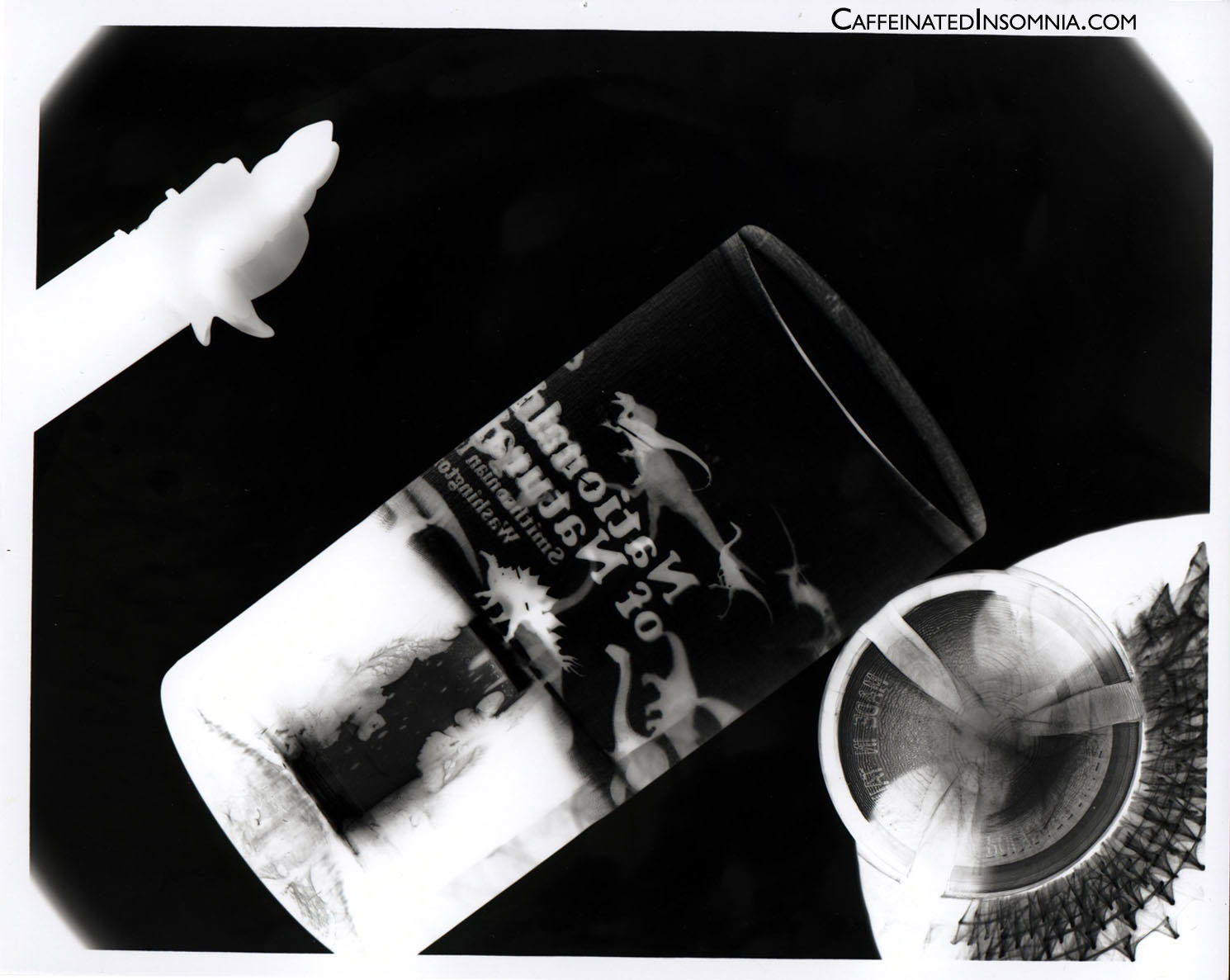
I really enjoyed this weeks in-class demonstration of how to create rayograms. The process itself was simple enough, turn off the lights to prevent exposing the film before you are ready to do so, place objects onto film while trying not to kill yourself by tripping over objects in complete darkness, flip lights on and off at lightning speed, and then start the tedious process of developing the film. Wash, rinse, and repeat. No, wait… that’s a different process entirely. Trying to develop the film for just the right amount of time was really tricky, since it was dark and the red light from the safety light did not really show much of what was going on, but for our first try, I think my group’s turned out pretty well.

Will had brought some of these notebook paper hole repair stickers as one of his items for the project, and they produced a really nice effect on the film, especially when some of them were complete circles and others went more at an angle off of the side of the film strip. The strips of film that had already been processed also made a really nice effect when they were placed over the undeveloped film. Our strip of already developed film had bands where the light had been able to get through to our film underneath, and it just looked really neat.

Two things that provided the best look in the experiment were hay, which Will had also brought with him, and the short grained rice that had been provided as an item for the entire class to use. The hay ended up producing a smoky, wispy effect on the film. It was just a really cool texture, overall. It could not really be seen by just looking at the film strip with a little bit of backing light, but when held up to the light, the detail was really noticeable and was really fine. I think the short grained rice had to have been my favorite item overall, though. Depending on how the individual grains fell, little bits of light would fall between the grains, and it ended up producing a really nice texture and overlapping effect on the film.

The glass beads provided for use, both the solid ones and the slightly cracked ones, produced an okay effect with nice curves and crescent moon shapes, but I was kind of expecting more fragmentation of light, which was produced more by the shards of beads than the actual beads themselves. Perhaps that is something that I will play around with more when we are able to do a second film strip.

With what Will and I were able to do with the items last week, I think we have a lot of elements that will incorporate into our film really well, and we both have ideas for other items that could enhance the textural aspect of the film even more, such as more masking tape and other things with faint textures that might be picked up on the film when the light develops it.

Overall, I would have to say that this process has been my favorite one so far. Even though I really enjoyed the magazine transfers, since those could really be manipulated to produce so many different desired effects, I think the actual development process of the rayograms was much more satisfying, and it was much more varied in the kinds of effects that could be produced, whereas with magazine transfers, everything was kind of dependent on whatever kind of magazines happened to be available.